Planning a holiday with children involves a particular kind of negotiation. Adults want something memorable; kids want something that holds their attention longer than twenty minutes. Kerala is unusually good at satisfying both sides of that equation, which is why it keeps appearing near the top of family travel lists and why a well-planned Kerala luxury tour package tends to generate the kind of holiday people actually talk about long after they’ve returned.
The state has jungles, beaches, backwaters, wildlife, spice plantations, and enough variety across its geography that even a ten-day trip rarely feels repetitive. Kerala also ranks consistently high for tourist safety and infrastructure, with KTDC (Kerala Tourism Development Corporation) operating one of the most organised state tourism networks in India. The question isn’t whether Kerala works for families. It does, reliably. The question is where to go, what to do, and what kind of accommodation makes the experience genuinely comfortable rather than merely tolerable.
Where to Take the Kids
- Munnar
Munnar is a natural starting point. At roughly 1,600 metres above sea level, the air is cool year-round, the tea estates roll out across the hills in every direction, and children tend to find the landscape genuinely exciting in a way that’s hard to manufacture. The Eravikulam National Park, home to the endangered Nilgiri tahr, offers a manageable trail where wildlife sightings are common, particularly between January and March when the animals graze closer to the paths. The Tea Museum in Nallathanni gives older children a clear, hands-on understanding of how tea goes from leaf to cup.
- Thekkady
Thekkady and the Periyar Tiger Reserve deserve more attention than they typically get in family travel writing. The boat safari on Periyar Lake runs for roughly two hours and regularly produces sightings of elephants, gaur, and spotted deer drinking at the waterline, often at close range. No hiking is involved, which makes it genuinely accessible for younger children and older family members. Spice plantation walks in the surrounding area introduce children to where cardamom, black pepper, and cinnamon come from, which can change how they see the kitchen spice rack when they get home.
- Alleppey
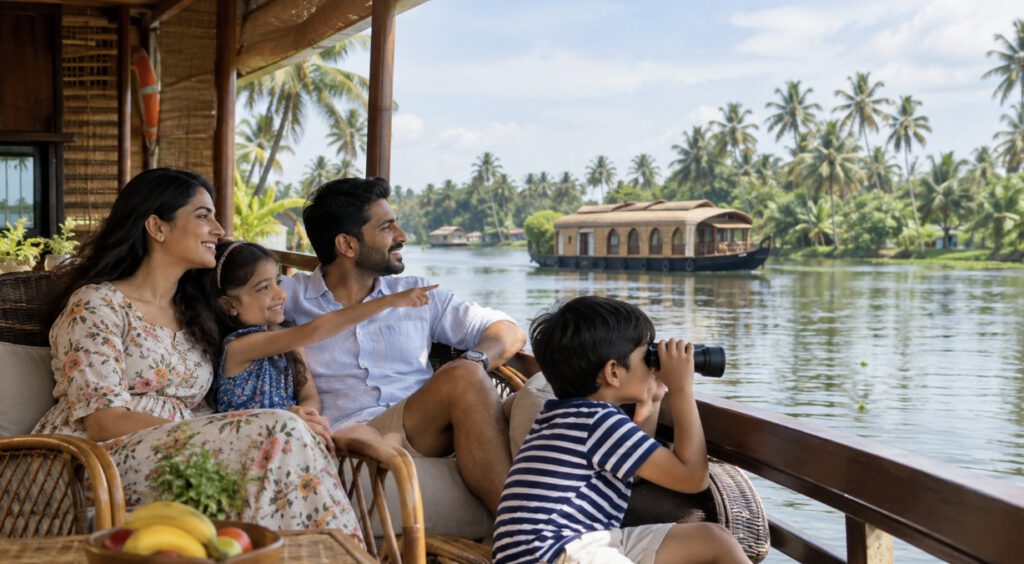
Alleppey and the Backwaters work particularly well for families when booked on a two- or three-bedroom houseboat. The Kerala backwater network covers approximately 900 kilometres of interconnected lakes, rivers, and canals, and cruising through it at low speed gives children the rare experience of watching a landscape unfold rather than being driven past it. A dedicated cook prepares meals on board, and the crew serves them on deck. The pace is slower than most family holidays, and that’s often exactly the point.
- Wayanad
Wayanad suits families who want the wildlife and forest experience without the longer drive to Thekkady. Pookode Lake offers pedal boating for younger children, Edakkal Caves bring prehistoric rock carvings within reach, and the area’s coffee and tea estates offer easy, pleasant walks. Wild elephant sightings on the roads between towns are genuinely common here, particularly around Sulthan Bathery and Muthanga.
- Varkala
Varkala works well as a coastal leg at the end of a hill-and-backwater itinerary. Both are quieter in character than Goa, which generally suits families better. The beaches are swimmable for much of the year, though currents can be strong and supervision is essential. You have enough to walk around in the evenings without feeling overstimulating.
Activities That Actually Work With Children
A few that reliably hold up:
Elephant encounters at ethical camps, such as Kodanad near Ernakulam and several Wayanad options, let children observe, and in some cases assist with, bathing and feeding elephants under supervision. This requires some research to ensure the camp operates responsibly, but when done properly it is among the more genuinely meaningful experiences a child can have on a trip.
Bamboo rafting on the Periyar River is calm enough for families with children above the age of around seven, and the forest corridor around it is worth the journey on its own terms.
Cooking demonstrations at homestays or resort kitchens, whether learning to crack open a coconut, grind spices, or make a simple Kerala curry, are the sort of activity that sounds modest and turns out to be one of the things children mention most when they get back to school.
Kathakali performances, particularly the shorter introductory versions offered at cultural centres in Thrissur and Kochi, work better with children than most people expect. The elaborate makeup and exaggerated expressions are inherently theatrical and cross the language barrier with ease.
Where to Stay
For families, accommodation matters most. Kerala offers three distinct stay types, and the right choice depends largely on your children’s ages and your baseline comfort needs.
| Stay Type | Best For | What to Expect | Recommended Options |
| Homestays | Families with older children, those wanting an immersive local experience | Space, home-cooked Kerala meals, kitchen gardens, host families willing to show children around the property and surroundings | Hill district homestays around Wayanad and Thekkady; look for ones with working spice or coffee estates |
| Luxury Resorts | Families with young children, those needing reliable infrastructure | Pools, dedicated children’s activity programmes, interconnecting rooms or private cottages, in-house dining that accommodates varied preferences | Kumarakom Lake Resort, CGH Earth properties (multiple locations), Windermere Estate in Munnar |
| Mid-Range Resorts | Families wanting comfort without full luxury pricing | Natural settings, decent room sizes, on-site dining, generally good value across Kerala’s hill and coastal regions | Well-represented across Munnar, Wayanad, Alleppey, and Kovalam |
What Families Frequently Ask
What is the best time of year for a Kerala family holiday? October to February is the most popular window. The weather is dry, temperatures are moderate, and visibility in the wildlife reserves is generally better. March to May is warmer but still manageable. The monsoon months (June to September) bring heavy rainfall but also lower prices, thinner crowds, and a landscape at its most dramatically green.
Is Kerala safe for families with young children? Kerala consistently ranks among India’s highest-literacy and best-governed states. Tourist infrastructure is well-developed, medical facilities are accessible in all major towns, and the general environment is considered safe and welcoming for families.
How long should a Kerala family trip be? A minimum of seven nights is advisable to cover two or three regions without the itinerary feeling rushed. Ten to twelve nights allows for a more comfortable pace across the hills, backwaters, and coast.
A Few Practical Notes
Kerala is a long state, running roughly 580 kilometres from north to south. Driving from Munnar to Alleppey to Kovalam in a single itinerary involves more time in a vehicle than most children find comfortable. A good Kerala family tour package builds in realistic travel time and avoids trying to cover the entire state in a week. Three or four destinations with genuine time at each consistently produce a better experience than six destinations where you have barely unpacked before moving on. The food is generally child-friendly. Rice, mild curries, banana chips, fresh coconut water, and seasonal fruit are staples across most menus. Authentic Kerala cooking can be spicy, but resorts and tourist-facing restaurants can easily moderate the heat on request. Roads in the hill districts are winding, and some children are prone to motion sickness on the longer stretches into Munnar or Wayanad. Factor this in when planning driving days, and keep long drives in the morning rather than the afternoon.
Come with a loose plan, leave room for the unscheduled stops, and let the state do the rest.

#Himalayas & #Northeast
Cinephile, Misanthrope, Anti-selfie
Atlas Obscura/Mint/Discover India