Arriving in Egypt has a way of sharpening the senses. In Luxor, there’s the dry warmth rising from pale stone, the distant hum of boats on the Nile and the sudden scale of a temple pylon appearing beyond the traffic. In Cairo, it might be the call of a street seller, the scent of strong coffee and the sight of ancient objects sitting a short journey from a city of millions.
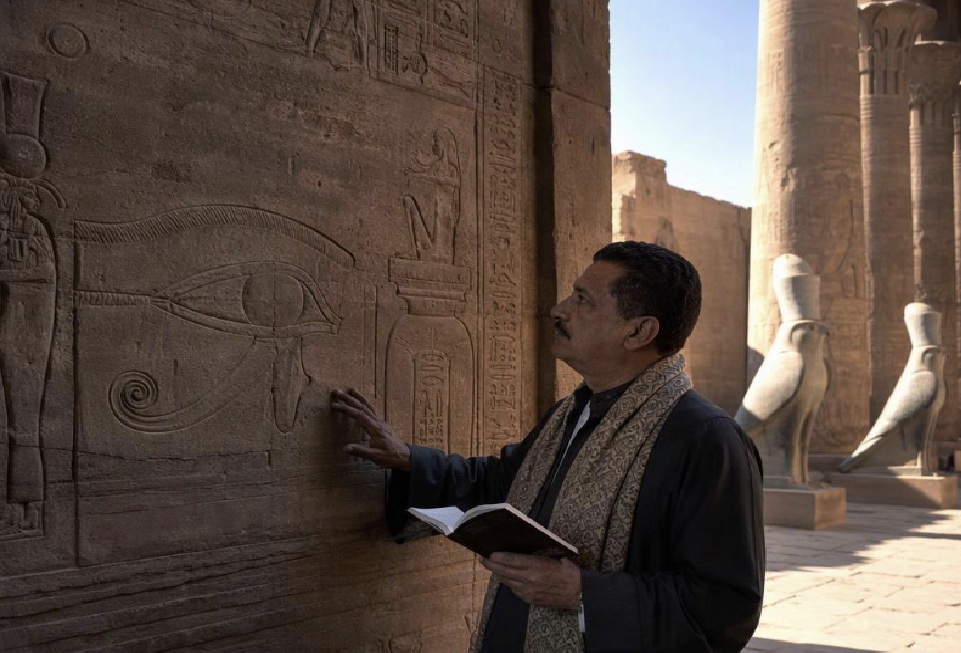
Among all those details, one image starts to stand out: the stylised Eye of Horus. You’ll spot it in museum cases, on replicas in shop windows and, if you look carefully at context rather than simply hunting for a familiar motif, within the much wider visual language of ancient Egyptian religion.
It’s worth approaching the symbol as a clue to a complex civilisation, not as a treasure-hunt tick-box. Egypt’s monuments are more rewarding when you slow down, read the labels and let each place explain a little of its own story.
The Eye of Horus, beyond the souvenir-shop version
The Eye of Horus is often called the wedjat, a word connected with wholeness and soundness. In ancient Egyptian belief, it was associated with protection, healing and restoration. The story behind it concerns Horus and Set: in their conflict, Horus’s eye was damaged or lost, then restored. That repaired eye became a powerful religious image, linked with renewal and offerings for the dead.
It wasn’t merely decorative. The motif appeared on amulets, coffins, boats and funerary objects across many centuries. The Met Museum’s overview of the Eye of Horus is a useful starting point before travelling, particularly if you’d like to understand why an apparently small amulet carried such weight.
There are a few useful things to remember when you see it:
- Protection was central, particularly in funerary settings.
- The symbol could relate to healing and completeness, rather than one simple modern meaning.
- Context matters. An eye on an amulet, a coffin or a temple relief may have distinct purposes.
- It belongs to a living national heritage, not just to the souvenir trade.
You’ll sometimes hear the Eye of Horus casually treated as interchangeable with the Eye of Ra. They can overlap in popular conversation, but they are not automatically the same thing. Ancient Egyptian religion changed over long periods, and its symbolism was not always fixed in the neat way modern guidebooks suggest.
**Adults-only entertainment aside:** For adults in places where online gambling is legal, the symbol has also inspired digital entertainment, including this clearly labelled eye of horus slot on Rainbow Riches Casino. It is separate from Egypt travel and heritage interpretation. Gambling should be treated as adult-only entertainment, with limits in place and never as a way to solve money worries.
Cairo and Giza: begin with objects, not assumptions
Cairo is the sensible place to start if you want to understand what you’ll later see at temples and tombs. The Egyptian Museum and the Grand Egyptian Museum present objects that can otherwise feel abstract when mentioned in a guidebook: protective amulets, jewellery, stone vessels, coffins, statues and funerary equipment.
Museum collections reward patience. Rather than rushing towards the most famous galleries, spend time with the labels around smaller objects. A tiny faience amulet may tell you more about daily beliefs and burial customs than a hurried photograph of a headline piece.
When you’re looking at an Eye of Horus object, ask yourself:
- What is it made from? Faience, gold, stone and glass each point to different techniques and contexts.
- Where was it found? A tomb, temple or domestic setting changes the interpretation.
- Who might have used it? Elite burials are prominent in museum displays, but ancient Egypt was never one uniform experience.
- How old is it? Egypt’s history stretches across millennia, so a symbol can have a long and changing life.
The Grand Egyptian Museum’s arrangements, galleries and ticket processes can change as further spaces open and operational plans develop. Check the official Grand Egyptian Museum website close to your visit, then book any timed entry in advance where required. The same applies to the Egyptian Museum in Tahrir Square. Do not rely on an old blog post for opening hours.
For Giza, aim for an early start. The plateau is exposed, busy and physically demanding under the sun. Take water, wear shoes that handle uneven ground and give yourself more time than you think you’ll need. The pyramids are extraordinary, but the experience improves when you accept that queues, security checks and access rules are part of the day.
Luxor on foot: reading temples and tombs with care
Luxor is where ancient Egyptian imagery begins to feel architectural. At Karnak, walls, columns, gateways and processional routes create a vast ceremonial landscape. Luxor Temple, closer to the modern city, offers another perspective on royal ritual and the relationship between monument, river and settlement.
You may see Horus represented in several forms, including the falcon-headed deity and the falcon itself. Protective motifs, royal names and scenes of offerings appear alongside one another. The exact reliefs accessible on a given day can depend on conservation work, crowd management and site rules, so avoid planning around one supposedly guaranteed photo opportunity.
On the West Bank, tomb visits bring a different mood. Painted scenes and carved inscriptions were not designed as museum displays. They were part of carefully prepared burial environments, relating to identity, ritual, memory and hopes for the afterlife. Keep your torch off if instructed, stay on the marked route and never touch a painted surface. Skin oils, bags and even a casual hand against a wall can contribute to damage over time.
A good guide can make a real difference here. Look for a properly licensed guide who is happy to say, “We don’t know”, when evidence is uncertain. That’s a reassuring sign, not a disappointing one. Egyptology is full of scholarly debate, and a thoughtful explanation is far more useful than a dramatic tale presented as fact.
Aswan, Edfu and the Nile: let the river shape the route
Travelling south changes the pace. Aswan is often gentler after Cairo and Luxor, with the Nile more visibly at the centre of daily life. It’s a fine place to pause, take a felucca trip where conditions allow and remember that Egypt is not a frozen ancient backdrop. It is a modern country with many communities, languages, histories and viewpoints.
Between Luxor and Aswan, Edfu is the major stop for anyone interested in Horus. The Temple of Horus at Edfu is among Egypt’s best-preserved temples, largely because it was buried beneath accumulated settlement for centuries before excavation. Its scale and condition can make the religious world of temple ritual easier to imagine, though it still needs careful reading rather than easy assumptions.
The temple’s inscriptions and reliefs draw on the mythology of Horus and on kingship. Take time to notice how the building directs your movement: gateway, courtyard, hall and sanctuary. Temples were controlled sacred spaces, not public museums in the modern sense.
There are several practical ways to connect this stretch of Egypt:
- Nile cruise: Convenient for combining Luxor, Edfu, Kom Ombo and Aswan, with organised shore visits.
- Train: A useful option between major cities, though booking arrangements and service standards vary.
- Private road transfer: Flexible, especially for a tailored itinerary, but use a reputable operator and allow for checkpoints and changing road conditions.
- Domestic flight: Helpful when time is limited, particularly for Cairo to Aswan or Luxor.
Whichever route you choose, plan around heat rather than fighting it. Start major sites early, carry refillable water where possible, wear a hat and leave room for a slower middle of the day. Even seasoned walkers can underestimate the combined effect of sun, dust and long distances.
A few practical habits that save bother
Egypt rewards travellers who prepare, but not those who over-schedule every minute. A little flexibility goes a long way.
Before visiting any museum, temple or tomb:
- Verify opening hours and ticket prices through the official Visit Egypt website or the venue’s own channels.
- Check whether separate tickets are needed for particular tombs, galleries or photography.
- Carry some Egyptian pounds in small notes for tips, toilets and minor purchases, while keeping cards as a back-up.
- Ask before photographing people, especially in markets and villages.
- Dress respectfully at religious places and avoid treating active places of worship as scenery.
- Use registered transport where possible, and agree fares or use a known booking method before setting off.
Photography rules deserve special attention. They vary by site, gallery and even room. A phone may be permitted where a larger camera is not; flash, tripods and filming may be restricted. If a guard says no photographs, accept it gracefully. The moment is still yours, even without a picture of it.
For current safety, entry and local legal guidance, British visitors should also consult the FCDO travel advice for Egypt before departure.
Leave the reliefs for the next visitor
The most responsible way to follow the Eye of Horus through Egypt is to resist the urge to possess every encounter with it. You don’t need to rub a carving for luck, climb where access is restricted or buy an object with doubtful provenance. In fact, those choices weaken the very heritage you came to see.
Buy from transparent, reputable makers and shops. Treat antiquities with proper documentation and export permissions as a serious matter, not a holiday curiosity. Support official museums, local craftspeople and guides who share knowledge with care.
Above all, listen. Egyptian history is vast, but contemporary Egyptian voices belong in the journey too: the person explaining a family recipe, the guide discussing conservation pressures, the shopkeeper describing their neighbourhood, the boat crew pointing out life on the river.
The Eye of Horus may be ancient, but it needn’t become a cliché. Seen in a museum case, on a temple wall or in the quiet detail of a tomb, it can be a reminder to travel with open eyes, a little patience and genuine respect.

#Himalayas & #Northeast
Cinephile, Misanthrope, Anti-selfie
Atlas Obscura/Mint/Discover India